
EMBASSY OF THE REPUBLIC OF CUBA IN TRINIDAD AND TOBAGO - SPECIAL BULLETIN-
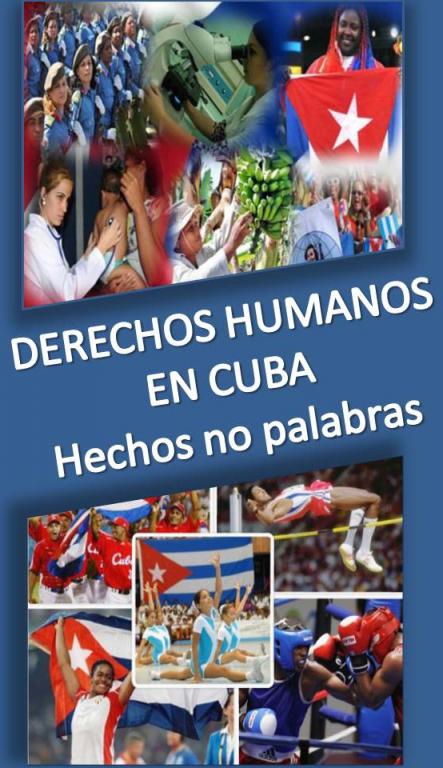
Twenty Cuban milestones in the field of human rights during the last five years
Cuba will present its Universal Periodic Review (UPR) on My 16 at the Human Rights Council
The appointment will be a new opportunity to expose the advances in the application of an economic and social model that has at its centre the human being and seeks to conquer the greatest amount of justice possible.
This is the third time that our country has submitted to the mechanism, which assesses the human rights performance of all the members of the United Nations every four and a half years.
The last time Cuba was presented was in May 2013. The Cuban newspaper, Granma, shares with its readers some of the milestones registered during the last five years.
1.THE DECLARATION OF LATIN AMERICA AND THE CARIBBEAN AS A PEACE ZONE
The Declaration of Latin America and the Caribbean as a Peace Zone, signed by the member countries of the Community of Latin American and Caribbean States (CELAC), during the II Summit of the mechanism in Havana, in January 2014, constitutes an indisputable contribution of Cuba to the stability and development of the region.
The proclamation establishes "the commitment of the States of the region with the strict fulfilment of their obligation not to intervene, directly or indirectly, in the internal affairs of any other State and to observe the principles of national sovereignty, equal rights and free determination of the people”.
2. ENTRY INTO FORCE OF A NEW LABOUR CODE
With the entry into force of Law 116, Labour Code, in 2014, Cuba updated its legislation in this field to include new rights that place it in the international vanguard.
Among other aspects, the new Code recognizes equality at work and that every citizen has the right to obtain a job, without discrimination due to skin colour, gender, religious beliefs, sexual orientation, territorial origin, disability or any other harmful distinction to human dignity.
3. PRESIDING THE WHO WORLD ASSEMBLY
In May 2014, Cuba served as Chair of the 67th World Health Assembly, held at the Palais des Nations, in the Swiss city of Geneva, which was attended by representatives of the 194-member countries of the World Health Organization (WHO).
Cuba was congratulated for leading the Assembly and highlighted the solidarity of the Greater Antilles with the rest of the world, where tens of thousands of Cuban doctors and specialists have helped save millions of lives since the triumph of the Revolution.

Cuba was among the first countries to respond to WHO's call to fight the Ebola epidemic. Photo: Archivo Granma
4. COMBAT THE EBOLA.
Cuba gave a quick response to the urgent call for help to combat Ebola, made in 2014 by the United Nations and WHO. Cuba sent 262 doctors and nurses specialized in health care emergencies who worked continuously in Sierra Leone, Guinea and Liberia for almost seven months, until they finally managed to control the epidemic.
In May 2017, during the 70th World Health Assembly, the WHO awarded the Lee Jong-wook Memorial Prize to the Cuban medical contingent Brigade Henry Reeve, in recognition of work in the face of natural disasters and serious epidemics.
5. POLICY TO MEET THE DEMOGRAPHIC DYNAMICS
During 2014, the Cuban government began to test a series of measures to address the aging of the population, one of the greatest challenges facing the country due to its impact on social, economic and family life.
Decisive steps to stimulate the birth rate, meet the needs of the growing population of the elderly, as well as promote the majority and efficient employment of people suitable for work, as part of the social interest to guarantee the fundamental rights of all citizens.
6. RE-ESTABLISHMENT OF RELATIONS WITH THE UNITED STATES
On December 17, 2014, the decision of the presidents of Cuba and the United States to work for the restoration of diplomatic ties was announced. The advances achieved during the following two years, which allowed the signing of 22 agreements on issues of mutual interest, demonstrated the Cuban will to maintain civilized relations with its neighbour despite the existing differences, provided that there is a respectful and equal treatment of conditions.
7. FIRST COUNTRY TO ELIMINATE THE MOTHER-TO-CHILD TRANSMISSION OF HIV AND THE CONGENITAL SYPHILIS
After a rigorous review led by the Regional Validation Committee, together with the Pan American Health Organization, the United Nations Children's Fund and the Joint United Nations Program on HIV -which covered fundamental aspects of care medical up to human rights-, in June 2015, Cuba became the first country in the world to receive validation of the elimination of mother-to-child transmission of HIV and congenital syphilis.
8. “I CAN” REACHES MORE THAN TEN MILLION PEOPLE
At the end of 2015, the Cuban literacy method "I Can" reached more than ten million people worldwide, of which more than nine million people learned to read. Among the main UNESCO recognitions that this Cuban initiative has received are the King Seijong Honorable Mention (2002, 2003) and the homonymous award conferred in 2006.
9. RE-ELECTION FOR THE HUMAN RIGHTS COUNCIL
Cuba was elected in 2006 as a full member and founder of the new Human Rights Council, called to overcome the selectivities and double standards of the former Commission.
Cuba served two consecutive terms (maximum established) and, after a pause, was once again selected as a full member in 2013 for the period from 2014 to 2016, and then re-elected in October 2016 for the 2017-2019 biennium, thanks to the support of 160 countries in the United Nations General Assembly.

Havana hosted a historic meeting between the leaders of the Catholic and Russian Orthodox churches. Photo: Ismael Francisco
10. HISTORICAL ENCOUNTER BETWEEN THE CATHOLIC AND RUSSIAN ORTHODOX CHURCHES
Havana hosted, in February 2016, a historic meeting between Pope Francis and the Patriarch of the Russian Orthodox Church, His Holiness Kirill, first meeting of the leaders of both churches after the schism of Christianity in 1054.
"If this continues, Cuba will be the capital of unity," said His Holiness Francisco in recognition of our country's efforts in favour of international peace and understanding.
11. THE LOWEST CHILD MORTALITY IN HISTORY
In 2017, Cuba obtained the lowest rates of infant mortality in its history, by reducing the rate to 4,040 per thousand live births. This figure places it at the level of developed nations in Europe, among others.
12. DEBATE OF THE DOCUMENTS OF THE 7th CONGRESS OF THE CUBAN COMMUNIST PARTY
In May of 2017 Cuba lived the celebration of the 7th Congress of the Party, where the Conceptualization of the economic and social model was presented, the bases for the national Plan of economic and social development until 2030 and the update of the 2016-2021 Guidelines, programmatic documents submitted later to a wide debate and then approved by the National Assembly. Its implementation will lead our socialism along the path of prosperity and sustainability.
13. LIFE TASK
Internationally, Cuba is a strong advocate of plans to reduce the impact of man on the environment. At the national level, a plan known as Life Task was approved, whose measures aim to mitigate the effects of climate change in the country in different scenarios: 2020, 2050 and 2100.
14. AID TO THE CARIBBEAN AFTER THE PASS OF HURRICANES IRMA AND MARIA
In the 2017 hurricane season, two powerful hurricanes, Irma and María, devastated several Caribbean nations. The level of disaster was a sample of the effects of climate change and also exposed the vulnerabilities of the region to the increasingly intense natural disasters.
Despite the fact that its territory was also seriously affected, Cuba sent solidarity aid to the Caribbean countries mostly affected.
15. VISIT OF EXPERTS ON HUMAN RIGHTS ISSUES
Our country maintains a high level of commitment to the procedures and mechanisms of the UN in reference to human rights; Proof of this were the visits made in 2017 by two independent experts from the United Nations, in response to an invitation extended by the Cuban Government.
The first one was Maria Grazia Giammarinaro, UN Special Rapporteur on the human rights of victims of human trafficking, especially women and children, and meanwhile, during the month of July in the Caribbean nation was Virgina Dandan, Independent Expert on human rights and international solidarity of the UN. Both highlighted the political will of Cuba in the issues addressed and highlighted the strengths of the Cuban model in aspects such as education, health, sports, among other social areas.
16. NEW CHANGES IN THE MIGRATORY POLICY
The 1st January 2018, new immigration measures came into force as part of the continuous and irreversible updating process that the country has been undergoing since January 2013.
With this group of measures, very well received by the Cuban community abroad, it was demonstrated once again the Cuban will to continue strengthening the bonds with citizens living abroad and also expand their rights and that of their relatives.
17. SAFEST COUNTRY TO DO TOURISM
On January 18th, Cuba was named “the safest country for tourism” in the 38th edition of the International Tourism Fair (FITUR) in Madrid, Spain.

The recent general elections showed the vitality of Cuban democracy. Photo: Juvenal Balán
18. ELECTION OF THE NEW NATIONAL ASSEMBLY OF POPULAR POWER
Between the year 2017 and 2018 the general elections were held in Cuba and the members of the IX Legislature of the National Assembly of Popular Power were chosen. The candidacy arose from more than 12,000 proposals made in the 970 plenary sessions (territorial and national) of mass organizations and students structures. Of the 605 elected candidates, 287 are district delegates. Their average age is 49 years and women, in particular, constitute 53.22%, which places us as the second Parliament in the world with the highest female participation, surpassed only by Rwanda with 61.3%.
19. ELECTION OF A NEW PRESIDENT OF THE COUNCIL OF STATE AND OF MINISTERS
As part of the general election process, elections were also held to choose a new State Council. Comrade Miguel Diaz-Canel Bermudez was elected as President of the Council of State and Ministers, completing the process of generational relief in the highest responsibilities of the Cuban State and Government, from the historical generation of the Revolution.
"In this Legislature there will be no room for those who aspire to a capitalist restoration; this Legislature will defend the Revolution and will continue the improvement of socialism," said Diaz-Canel before the deputies.
20. VENUE OF THE 37TH SESSION OF THE ECONOMIC COMMISSION FOR LATIN AMERICA AND THE CARIBBEAN
Cuba was chosen as the venue to celebrate the 70th anniversary of the Economic Commission for Latin America and the Caribbean (ECLAC) and assume its pro tempore presidency for the period 2018-2020.
The Executive Secretary of the ECLAC, Alicia Bárcena, highlighted the history of the Greater Antillean Island and its efforts to carry out a fair and inclusive social project.
"This country that welcomes us today, and it is right to underline it, is testing its own ways in the face of the brutal human costs that the imposition of an unjust blockade has imposed for more than 50 years," Bárcena said at the opening of the event, held in La Havana between May 8 and 11.
Taken from the Cuban newspaper Granma
Dated: May 14th, 2018
EMBASSY OF THE REPUBLIC OF CUBA
#74 Elm Avenue, Bayshore, Westmoorings,
http://misiones.minrex.gob.cu/es/trinidad-y-tobago