
Dear colleagues,
Dear friends of the Austria-Cuba Friendship Association,
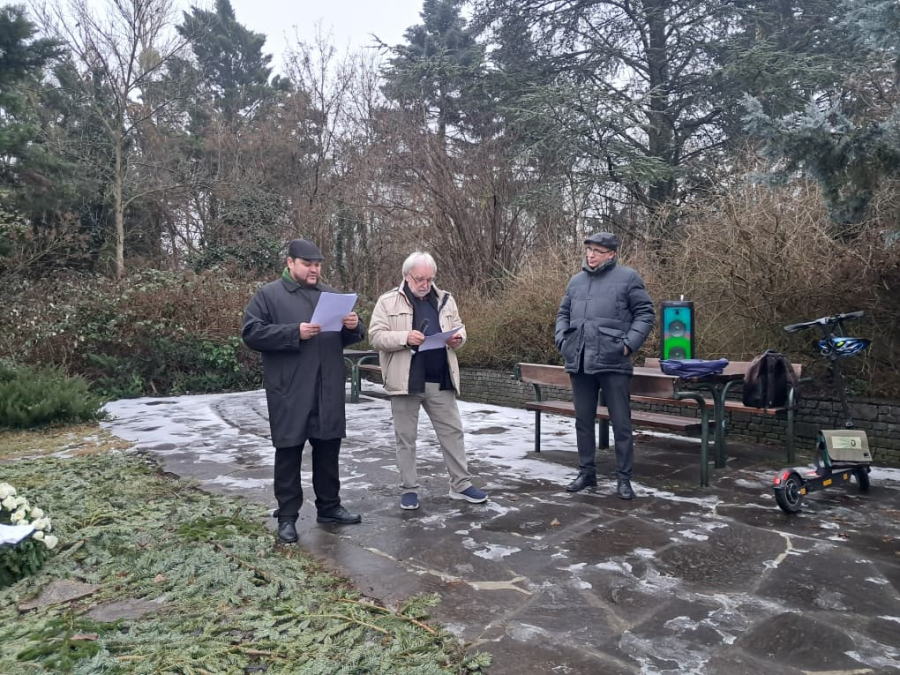
Once again, we gather in front of the bust of José Martí in this Latin American Plaza. Today, on the 173rd anniversary of his birth, his legacy not only illuminates our memory, but also illuminates our present with critical urgency.
Last year, we reflected here on Martí as the architect of continental unity. Today, that reflection becomes a necessary warning. Because the essence of his Latin Americanist thinking—which he forged by traveling throughout our geography and analyzing the power of the north with a relentless magnifying glass—resonates today not as a history lesson, but as an accurate diagnosis of the dangers that threaten Our America.
Martí taught us to distinguish. He lived in the United States and from there issued the most lucid warning: the greatest danger to our independence was not old Europe, but “the disdain of the formidable neighbor who does not know it.” That disdain, today, has mutated into stark aggression. We see it in the aggression against Venezuela. We hear it in the threats made against Cuba, which seek to revive the language of the Monroe Doctrine from beyond the grave.
That doctrine, which Martí denounced as the ambition to turn Latin America into the “backyard” of a power, has returned with force from Washington. It is not a relic of the 19th century; it is the roadmap for the empire's foreign policy in the 21st century.
Faced with this offensive, Martí's response is the only possible one: unwavering unity. Not rhetorical unity, but concrete alliance, the “united march” and the “tight cadre” that he advocated.
As Martí said: “A correct idea from a cave at the bottom of the ocean is more powerful than a thousand battleships.”
That is why, as he said, it is time to line up the trees so that the seven-league giant cannot pass. That line is active solidarity, it is the collective defense of Cuba, it is the unanimous voice against any interference.
José Martí's thinking helps us confront this global crisis. His ideas on solidarity range from the individual to all of humanity. According to Martí, the basis of human solidarity lies in the individual who respects and wants to give to other individuals.
This is manifested in Martí's ethic that any injustice anywhere in the world is suffered by himself. That is why Martí concluded that “Patriotism is nothing more than love” and “Homeland is humanity.”
On this day of the Apostle's birth, let us renew our commitment to international solidarity and
our conviction that the destiny of all the peoples of this planet depends on the actions that each of us takes at this moment.
Thank you very much.