
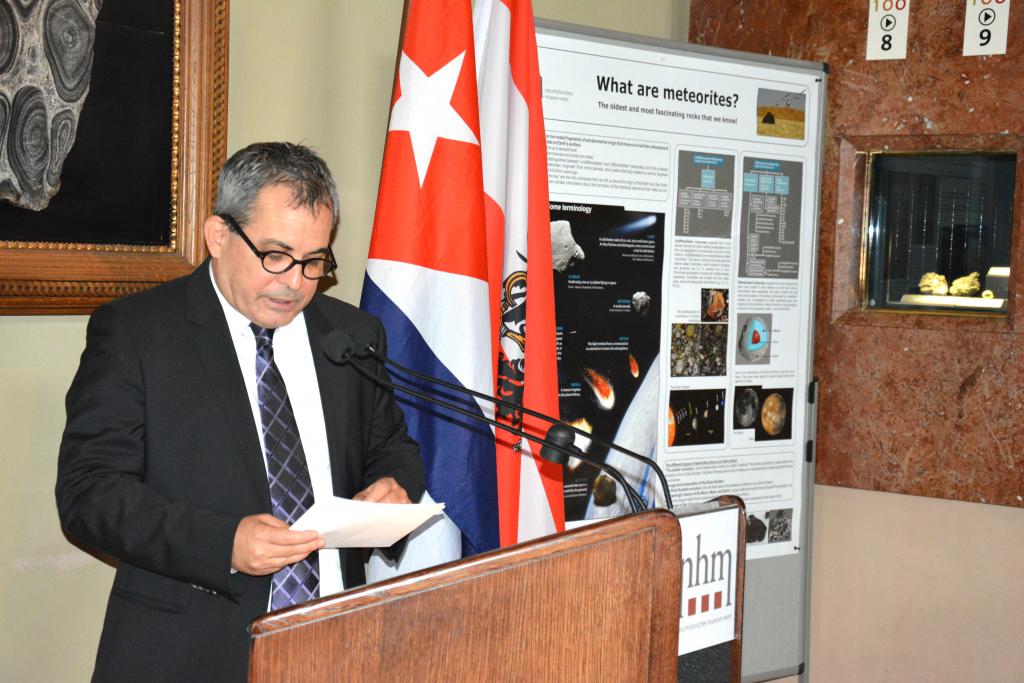
Dr. Christian Köberl, General Director of the Natural History Museum of Vienna,
Dr. Ludovic Ferrière, Senior Curator of the Museum´s Meteorite Collection,
Distinguished guests,
Dear Ladies and Gentlemen,
It was a sunny afternoon, with an intense blue sky, on 1 February 2019. The peaceful urban and rural balance was about to be broken in Pinar del Río, the westernmost province of Cuba. At approximately 13.20 hours, the neighbors of Viñales town heard an exceptional noise in the middle of the usual silence of the Cuban countryside. Their sound reached the capital of the province.
The human curiosity and the inherent restlessness of searching for answers in the sky, made many interrupt their daily lives to raise their eyes towards the horizon. It was a ball of fire of intense luminosity, the one that crossed the blue sky. For some it was a falling plane, for others the unrecorded tornado which was returning to conclude its evil destruction, as it had done four days before in four municipalities of Havana. There were other theories and versions, as well as skeptics.
But no one imagined that it was a meteorite that, as an unexpected guest, fell a few meters from the place where the festive activity was organized to celebrate the 18th anniversary, on that same day, 1 February, of the declaration of Viñales National Park, by agreement of the Council of Ministers.
Viñales Valley is a unique place in Cuba´s geography. Its natural values and cultural landscape made it to achieve the status of World Heritage Site by UNESCO in 1999. It is an area protected as a National Monument. Its singular beauty is given by the karst elevations (Mogotes) of remarkable morphology and by treasuring one of the largest and most exclusive cave systems in the Americas.
In this exceptional scenario, a cultural landscape is drawn, conformed by cave and contemporary paintings, and the singular aroma of its tobacco plantations of universal fame, being an example of harmony between man and nature.
It was then here, where the planned party could not take place, but where a large and multidisciplinary team of Cuban researchers and scientists arrived, and together with the support of local and national authorities, dedicated themselves to explain the mystery and study those rocks that fell from the sky.
Ladies and gentlemen,
Dr. Ludovic Ferrière's scientific and passionate curiosity, his dedication and proven skills, his communicating capacity and kind manners, have brought us here. It was he who initiated the contact, and it was the scientific community and the Cuban authorities, who in reciprocity, offered cooperation and dedication to make this singular moment possible.
Cuba is proud that a fragment of Viñales meteorite is part of the unparalleled exhibit preserved in this Natural History Museum in Vienna, the largest and most diverse in the world. This is a place where excellence, interest in truth and scientific rigor prevail. A place where the visitor has before his/her eyes nature in all its splendour, but not to the most daily or common part we usually contact with it, but to that other exotic and mystical nature. And here it is one of the supreme values of this Museum: to make available to human beings what is unattainable, being placed in its original and most authentic state. Certainly, it is a privilege and a unique opportunity.
Ladies and gentlemen,
Nations have many ways of cooperating with one another. Faced with the challenges of today´s world, many of which affect nature and the very survival of humanity, countries and their governments are urged to act in a coordinated and responsible manner in the search for urgent solutions to our main problems, where science must have a vanguard place.
And when there is someone in the power, who considers it to be infinite for himself, ignores the effects of climate change and ignores the commitments made to save the planet, giving an insolent slam to science and the future of humanity, in Cuba and Austria there are scientists working in a coordinated and generous way to make possible an event that surpasses its technical significance to become a historical fact that honors a friendly and cooperation relationship between our two nations that steadily extends for more than 70 years.
Once again, I express our appreciation to Dr. Christian Köberl, General Director of the Natural History Museum of Vienna; to the eminent scientists Ferrière and Iturralde, to the Institute of Geophysics and Astronomy and to the Ministry of Science, Technology and Environment of Cuba. From today, Viñales meteorite will be in the beautiful showcase along with other similar and diverse meteorites which visited us before, to be gazed at, by the thousands of curious visitors from all over the world who arrive here. I also thank you for allowing us to contribute in a modest way to materialize such a noble purpose, of which we are proud of.
I thank you very much

(Embacuba Austria)