
Distinguished members of the Diplomatic Missions of the sister Bolivarian Republic of Venezuela, Nicaragua, and Bolivia,
Dear friends of Cuba,
Compatriots,
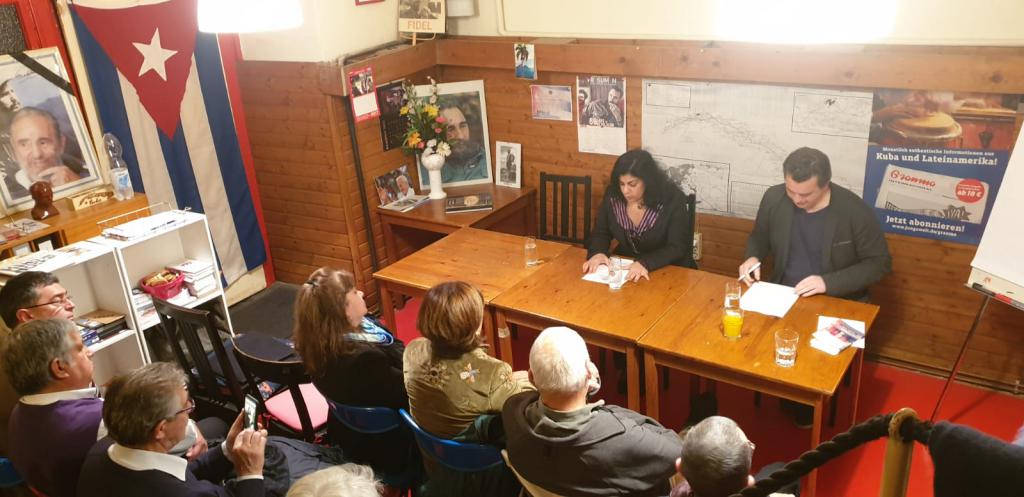
It is an honor, as Ambassador of Cuba to Austria, to begin my diplomatic mission and to introduce myself before the friends of Cuba, in this commemorative event on the occasion of the third anniversary of the physical death of the historic leader of the Cuban Revolution, Commander in Chief Fidel Castro Ruz.
I would like to thank ÖKG, the Austria-Cuba Friendship Association and "CubaVa", the Association of Resident Cubans for organizing and accompanying this evening.
For Cubans of all generations, Commander in Chief Fidel Castro represents social justice, dignity, independence, decorum. His legacy and example allow us to continue his work today, even though unfortunately he is not physically present.
Undoubtedly, this is one of the figures of universal dimension, who have left a mark on the history of the twentieth century.
From his youth, Fidel had the lineage of a leader. At the end of his high school studies at Belén College, in Havana, in 1945, his teachers wrote:
"He has known how to get admiration and affection…We do not doubt that he will fill the book of his life with brilliant pages. Fidel got the makings of winner and the artist will not lack."
As a law student at the University of Havana, he became involved in political struggles and held various positions in the University Student Federation (FEU, by its Spanish initials). Since then he has participated in various anti-imperialist organizations and in support of other Latin American peoples such as Puerto Rico and the Dominican Republic. He traveled to Venezuela, Panama and Colombia to organize a Latin American Student Conference, to be held in Bogota. He is surprised by "El Bogotazo" there and he also joins this struggle.
On the occasion of Fulgencio Batista´s coup d'état on 10 March 1952, he was among the first to denounce the reactionary and illegitimate character of the de facto regime and called for its overthrow. He organized the assault on Moncada and Bayamo Barracks on 26 July, 1953, an important action that triggered the armed struggle against the Batista regime. As a prisoner, he proclaimed his historic defense plea known internationally as "History will absolve me”. Later, the years of imprisonment, amnesty, exile in Mexico, the landing of the yacht Granma, the guerrilla struggle in the Sierra Maestra and finally the revolutionary triumph of 1 January, 1959.
Since then, he guided and participated in all actions undertaken in defense of the country and of the Revolution, in cases of military aggressions coming from abroad or activities of counterrevolutionary gangs inside the country, especially the defeat of the Bay of Pigs invasion, in April 1961.
His handling of the tense October Crisis was memorable. Che said: "Never has a statesman shone so brightly".
He survived more than 630 attempted attacks by the enemies of the Revolution.
Fidel devoted his life to the Socialist Revolution of the humble, by the humble and for the humble. He was always present at every difficult moment in the face of nature´s adversities and in the execution of crucial social, and economic projects, many of which he personally conceived.
He victoriously led the Cuban people in its struggle against the U.S. blockade, still in force, increasingly genocidal and extraterritorial.
His constant concern for the formation of new generations was notorious and instructive.
It was the voice of the underdeveloped world. He promoted on a world scale the Third World battle against the current international economic order and the struggle against imperialism, which plunders resources and limits the development of our nations.
Friends,
Fidel Castro has the merit of having promoted Cuba´s solidarity contribution in Cuban doctors, teachers and technicians in more than 60 Third World countries, as well as the realization of studies in Cuba by tens of thousands of students from those countries and the creation of an internationalist conscience in our people.
Fidel, together with Chávez, conceived ALBA, the most advanced project of unity that has ever existed in Latin America and the Caribbean, an agreement whose basis lay in the people, in their infinite capacity for solidarity. Hundreds of thousands of Latin Americans had health, education, and recovered their sight and dignity. Today, imperialism is trying to dismantle these conquests, which it fears so much. It is opportune to remember, on the eve of this third anniversary of the physical departure of Commander in Chief Fidel Castro, that he was the man who dedicated his life to the defense of the unity of the peoples and nations of Latin America.
Fidel´s life and work is a daily lesson of struggle, of disagreement with perfectible reality, of rejection of injustice, of unity and resistance. It is the demonstration that there is no force capable of defeating a united people. His concept of Revolution is an exquisite explanation of our political process.
With his legacy, the Cuban people today continue its struggle against the empire, which attacks us and blocks us with greater crudity. The enemy is the same one that invaded us and we defeated in Bay of Pigs and in many other battles. The Revolution is a permanent task and what has been done must represent the guide and the conviction of how much we still have to do.
Fidel is not dead; he lives in the heart of his people and in the feeling of all revolutionaries and good men and women who love peace, freedom and dignity.
To continue his work is our best homage.
Always to the victory!
Long live Fidel
Thank you very much
(Embacuba Austria)