This article is a reflection on the application of the Cuban literacy methodology Yo, Sí Puedo to the Australian setting. The Yo, Sí Puedo / Yes, I Can! model developed in Cuba by the Instituto Pedagógico Latinoamericano y Caribeño, IPLAC (Institute of Pedagogy for Latin America and the Caribbean) has been successfully implemented across the Global South as a strategy of adult literacy. It is a legacy of our Latin American revolutionary roots, with its origin in the Freirean pedagogy of the oppressed.
H.E. the Ambassador Patricia L. Pego Guerra meets with Michael Dingake, in Gaborone.
Since the time he fought Apartheid with Nelson Mandela, Dingake is a close friend of Cuba and our people.
He is also an admirer of Commander in Chief Fidel Castro, historical leader of the Cuban Revolution.
It is always a pleasure to have him in the premises of the Embassy.
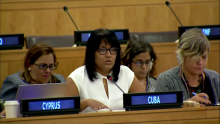
New York, 11 October 2017. The Cuban representative to the United Nations, First Secretary Juan Miguel González Peña, described the current international economic order as deeply unjust and unsustainable, with an increasing impact on the marginalization of a considerable number of nations of the South.
The XVIII Meeting of the Board of the Regional Cooperation Agreement for the Promotion of Nuclear Science and Technology in Latin America and the Caribbean (ARCAL) Representatives (BAR) has been held on 19 September 2017 in Vienna, Austria, in the framework of the 61st IAEA General Conference. This meeting was attended by representatives of ARCAL States Parties of the region, including Belize as a new ARCAL State Party.
CUBA’S REPORT On Resolution 71/5 of the United Nations General Assembly entitled “Necessity of ending the economic, commercial and financial blockade imposed by the United States of America against Cuba”