
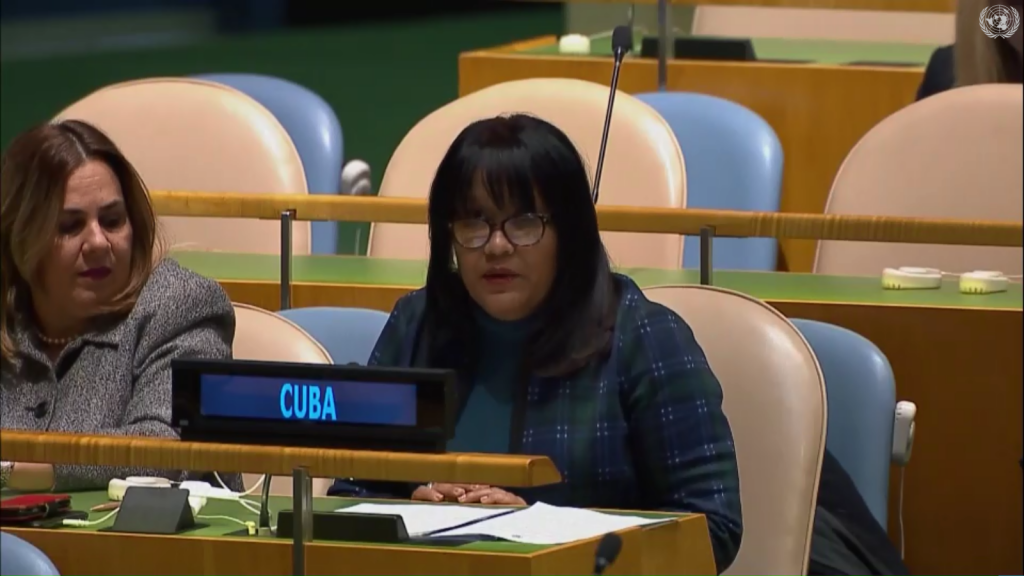
Madam Chair,
My delegation associates itself with the statement delivered by Egypt on behalf of the Group of 77 and China, and supports the Santo Domingo Declaration, adopted at the Regional Consultation prior to this session of the Commission on the Status of Women.
The priority theme of this session is significantly important in seeking viable alternatives that contribute to transforming the reality in which millions of women worldwide continue to live, particularly rural women.
We reaffirm the words of our President Raúl Castro Ruz at the Global Leaders’ Meeting on Gender Equality and Women's Empowerment held at this venue in September 2015, when he expressed: “In order to advance toward the full realization of gender equality and the empowerment of women, it is necessary above all to have a more equitable and just international order that eradicates poverty and hunger, puts an end to war conflicts, favors human beings above capital, and preserves the environment”.
In Cuba, attention to rural areas is a priority. In our national comprehensive development plans, rural areas have been included in a way to avoid gender discrimination in its legal and legal framework, which prevents rural women from empowering themselves as human beings in equal rights with men.
Rural women in Cuba show unquestionable advances in education and health. They also enjoy sexual and reproductive rights, family planning services and advanced Law on Maternity Care that makes it possible to enjoy prepartum and postpartum leave until the child reaches one year of age, to which any partner is entitled and which has recently been extended to working grandparents as well.
More than 200,000 Cuban women work in the agricultural food industry, including peasants, agricultural workers and technicians, who provide their daily contribution to food production, the improvement of species and anything that can contribute to food security and sovereignty, with due care and conservation of the environment.
The Cuban Constitution guarantees ownership over land without any discrimination on the basis of gender. On the other hand, the adoption of Decree-Law No. 300, which sets out regulations on access to usufruct for individuals, benefited thousands of women. Given the need to increase food production, more than 20 thousand women have been granted the ownership of land, with full access to credit, technical assistance and other opportunities, thus enabling them to manage, control and administer the land and resources, as well as to develop environmental principles.
Joint plans and programmes are currently conducted among the Ministries of Agriculture, the Sugar Industry, the National Association of Small Farmers (ANAP, by its Spanish acronyms) and the Federation of Cuban Women. In like manner, training courses have been implemented to foster advancement of rural women, achieve greater inclusion in the various economic activities and increase promotion at decision-making levels within the different agricultural food sectors.
My delegation takes great pride in expressing that, after the recently concluded general elections in Cuba, the presence of women in the National Assembly amounts to 53.22%, being the second parliament with largest female representation in the world.
Madam Chair,
These are only some examples of the Cuban Government's commitment to rigorously observe the international and regional conventions and agreements in favor of women.
All this has been possible despite the economic, commercial and financial blockade imposed by the United States against Cuba, which constitutes an obstacle to the full development of the country and the advancement of women. The blockade is also a form of direct and indirect violence that impacts and hinders the enjoyment of the fundamental rights of Cubans, particularly rural women.
Cuba reiterates its willingness to continue developing its social model based on justice, equality and solidarity, with strict adherence to the principles enshrined in the Charter of the United Nations and the Universal Declaration of Human Rights.
Thank you very much.