
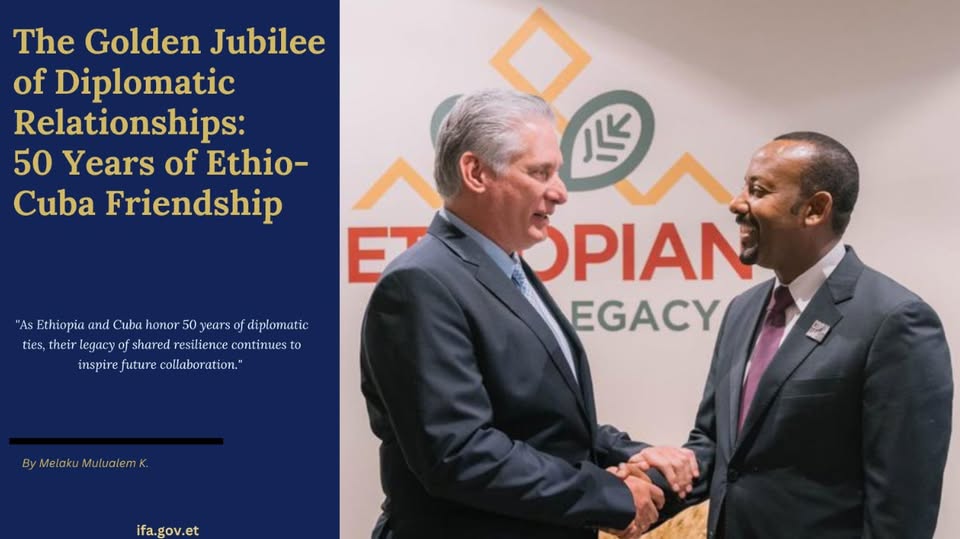
Addis Ababa, December 9, 2025.- This year marks the Golden Jubilee of the formal diplomatic relationship between Ethiopia and Cuba, a bond established in 1975. This half-century milestone is not merely a diplomatic anniversary; it is a commemoration of a profound, blood-sealed solidarity that helped preserve a nation’s sovereignty.
The foundation of this unique relationship was laid during the brutal Ogaden War. On 13 July 1977, Somalia, under President Ziad Barre, invaded eastern Ethiopia to fulfill its irredentist ambition of creating a “Greater Somalia.” The Somali soldiers advanced rapidly, seizing control of significant territory in the Ogaden region. Ethiopia, simultaneously grappling with internal conflicts against groups like the EPLF (Shabia) the TPLF and EPRP, that led to an existential threat to its territorial integrity.
It was at this critical juncture that Cuba, under the steadfast leadership of President Fidel Castro, answered the call. In a stunning act of international solidarity, Cuba dispatched 15,000 soldiers to fight alongside the Ethiopian forces. At one time Fiedel Castro was asked by a Western journalists how many military advisors and soldiers of Cuba are working in Ethiopia. He responded saying “Why you ask details, I cannot work for CIA”.
The support of Ethiopia was not an isolated act but part of Cuba’s broader commitment to African liberation, having supported freedom fighters in Algeria, Angola, Mozambique, against apartheid in South Africa and the like. As the late President Nelson Mandela once stated, “Cubans are in the hearts of Africa.”
The war was bloody, resulting in massive casualties and displacement. About 163 Cuban soldiers made the ultimate sacrifice, with others taken as prisoners of war in Somalia. Their contribution was decisive. The turning point came at the Battle of Karamara, where the joint Ethio-Cuban forces secured a victory that ultimately chased out the invaders and guaranteed Ethiopia’s sovereignty. By the support of Cuba and other allies, Ethiopia won the war, while Somalia’s ambition lay in ruins. After the death of Ziad Bare Somalia faced state collapse and remained so for decades.
This shared history of struggle created an unbreakable bond. As the saying goes, “A friend in need is a friend indeed.” For Ethiopia and Africa at large, Cuba paid a selfless sacrifice—a policy of “give” rather than “give and take.” The relationship was, as many veterans from both nations who still remember each other’s friendship would attest, cemented by blood.
The diplomatic and personal exchanges further solidified ties. Fidel Castro visited Ethiopia in 1978, attending a military parade in Meskel Square sitting on the Tribune where the former office of the Institute of Foreign Affairs located. President Castro had also travelled to Jigjiga to celebrate the victory. Similarly, President Mengistu Hailemariam visited Cuba in March 1978. During this time it was Castro himself who was driving the car to show his solidarity. These gestures underscored a partnership based on shared values and mutual respect.
In the heart of Addis Ababa stands the Ethiopia-Cuba Friendship Memorial Park. The Park was inaugurated in 1984 during the Mengistu regime’s ten years national celebration. Its 50-meter-high monument, decorated with sculptures of intertwined Ethiopian-Cuban soldiers, is a solemn tribute to the Cuban soldiers and military advisors who fell on Ethiopian soil. In this Park, there are photos of Cubans who lost their life in the Ogaden War. This park has become a living symbol of gratitude, where Ethiopians gathered in 2016 to mourn the passing of Fidel Castro, a man the African Union praised as “a freedom fighter who supported Africa’s struggles.” The then President Mulatu Teshome of Ethiopia attended the funeral service on December 3, 2016 in Santiago de Cuba.
Beyond the battlefield, Cuba’s support extended to nurturing Ethiopia’s future. In a compassionate post-war gesture, about 5,000 Ethiopian children who had lost parents in the conflict received scholarships to study in Cuba. This generation returned as doctors, engineers, and professionals. Today, many Ethiopian graduates from Cuban universities work in vital sectors, while cultural intermingling continues. These opportunities created continuing people-to-people links, including intermarriages and Cuban expatriate communities in Ethiopia. The cooperation also touched on social campaigns. Cuba supported Ethiopia’s national literacy drive, helping adults learn to read and write. And in a lighter, yet enduring cultural exchange, the Cuban love song “Guantanamera” became, and remains, a popular melody in Ethiopia—a tune that symbolizes the warm, people-centered nature of the bond.
As Ethiopia and Cuba celebrate this Golden Jubilee, the relationship rests on a solid historical foundation but is dynamically oriented toward the future. Both nations maintain embassies in each other’s capitals and are actively working to mark a new chapter within the framework of South-South Cooperation.
The current partnership is being expanded through various Memoranda of Understanding (MoUs), exploring renewed collaboration in economics, health, education, and technology. The need to explore more areas of cooperation is clear, building on the unparalleled political goodwill that exists.
This relationship is historically unique, rooted in a shared struggle for sovereignty and justice. It is deepened by the African ancestry of many Cubans—a connection forged through the tragic history of the Atlantic Slave Trade and the role of Afro-descendants in Cuba’s own liberation from Spanish colonialism. This creates a historical and blood relationship between Africa and Cuba that transcends diplomacy.
The durable lesson of the past fifty years is that true partnership is built on principles, not just interests. Cuba’s decisive intervention was a testament to its commitment to African independence and justice. Ethiopia’s enduring gratitude is evident in its remembrance and continued friendship.
As both nations look ahead, the deep-rooted ties—nurtured by veterans, alumni, artists, and diplomats—provide a resilient framework. The Golden Jubilee is not just a milestone to reflect on a heroic past, but a launching pad for a future where the spirit of Karamara evolves into shared victories in development, innovation, and mutual prosperity. The friend in need has proven to be a friend indeed.
By: Melaku Mulualem K.,Director General for TrainingInstitute of Foreign Affairs
(EmbaCuba-Etiopía)