
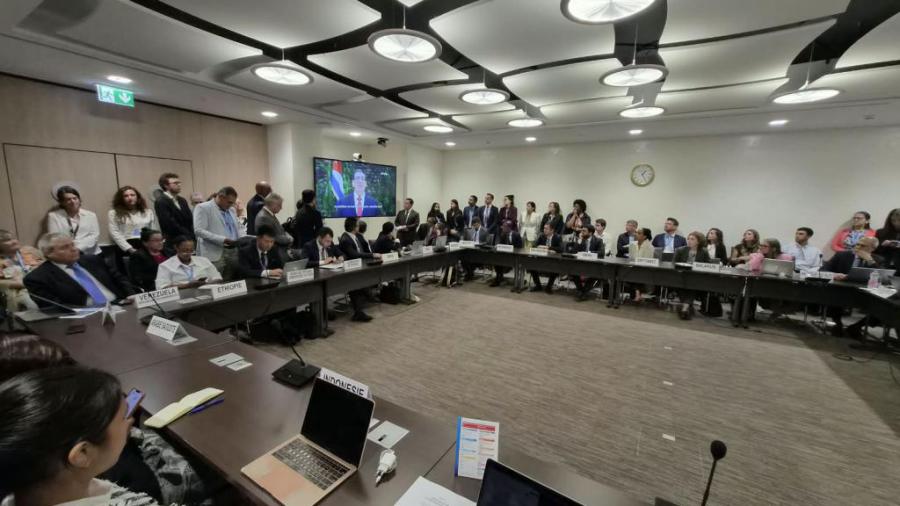
Geneva, September 10, 2026. In a packed room that forced many participants to remain standing, the United Nations Office in this Swiss city hosted an academic and political discussion under the theme: “Suffocation as Policy: The Human Cost of the Blockade Against Cuba.”
The event, moderated by Ambassador Rodolfo Benítez Verson, Permanent Representative of Cuba to the United Nations in Geneva, provided an opportunity for an in-depth exchange on the impact of the intensification of the hostile and aggressive policy pursued by the Government of the United States against Cuba, as well as to identify practical actions to address this escalation within the multilateral system, particularly at the United Nations Human Rights Council.
The opening presentations were delivered by highly respected and internationally recognized experts, including Zaina Jallad, Special Rapporteur on the negative impact of the unilateral coercive measures of the Human Rights Council; George Katrougalos, Independent Expert of the Council on the promotion of a democratic and equitable international order; Guillaume Long, Senior Research Fellow at the Center for Economic and Policy Research in Washington; and Alfred Maurice de Zayas, Professor at the Geneva School of Diplomacy and International Relations, Switzerland.
Participants also had the opportunity to hear a special video address by Cuban Foreign Minister Bruno Rodríguez Parrilla. The Cuban minister provided updated information on United States policy towards Cuba and the damage it causes across all areas. He reported that, on October 27 and 28, the United Nations General Assembly will once again consider the issue of the blockade against Cuba. He stressed that, despite the extraordinary pressure exerted by the Government of the United States, Cuba will once again receive overwhelming support in the vote on the resolution on October 29.
Several speakers agreed that this is a deliberate, carefully structured and coldly calculated plan by the Government of the United States, aimed at creating extreme shortages for Cuban families and generating a humanitarian crisis in order to destabilize the country and achieve its historic objective of defeating the Cuban Revolution.
In this context, participants denounced the extreme tightening of the blockade imposed on Cuba in recent months, including a brutal energy siege and secondary sanctions against entities and individuals in third countries simply for maintaining ties with the Island.
There was also widespread concern over the enormous humanitarian impact of this escalation and its consequent deterioration in the quality of life of the Cuban people, despite the efforts of the Cuban Government to protect the population and mitigate, to the greatest extent possible, the resulting harm.
Reference was made to the significance of having, for the first time, brought the issue of the United States economic, commercial and financial blockade against Cuba before the Human Rights Council for examination. In this context, participants also highlighted as a highly positive development the fact that, for the first time, an independent specialized mechanism of the United Nations system had presented an assessment to the Council of the damage caused by the blockade, based on evidence directly verified on the ground by the Special Rapporteur on unilateral coercive measures during her visit to Cuba.
The Special Rapporteur’s important recommendations concerning the practical steps that the Government of the United States should take with regard to Cuba were also highlighted. These include lifting all coercive measures against Cuba; removing restrictions on the supply of essential goods; ending Cuba’s designation as a State Sponsor of Terrorism; repealing the national emergency declaration based on the alleged threat posed by Cuba; ending fines imposed on banks for ties with Cuba; removing all obstacles to the sending of remittances; and resolving differences with Cuba through dialogue rather than pressure.
Participants expressed their support and solidarity with Cuba, as well as their recognition of the country’s resilience and steadfastness in the face of the escalation of hostility, pressure and the extreme tightening of the blockade.
Representatives of numerous countries, international organizations, non-governmental organizations and academic institutions participated in the event.

