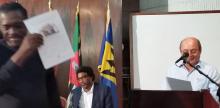
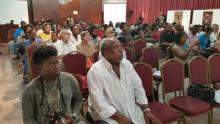
Port of Spain, 29 October.- The official of the Cuban Institute of Friendship with the Peoples (ICAP) Yamil Martinez Marrero, in charge of the Eastern Caribbean countries in this institution, culminated today an intense and fruitful three days working visit to Trinidad and Tobago, which among its main goals were to update the movement of solidarity with Cuba, political parties and labor movements with a comprehensive socio-economic situation on Cuba in its current political context and exchange on possible initiatives in support of Cuba for the next year.
Port of Spain, 28 October.- In the 56 anniversary of the physical disappearance of the “Hero of Yaguajay”, a broad representation of Cuban health collaborators in Port of Spain and members of the diplomatic mission in Trinidad and Tobago, paid tribute to Camilo Cienfuegos in a small boardwalk of the Trinitarian capital.
Ratifying the historical position of Barbados in support of the Cuban resolution "Necessity of ending the economic, commercial and financial embargo imposed by the United States to Cuba" presented for 25 consecutive years before the General Assembly of the United Nations, Prime Minister Freundel Stuart included in his speech to the general debate of the world organization the requirement that such unilateral sanction to be lifted completely. Similar position has been expressed in the past by the Barbadian Foreign Minister Maxine McClean in different international forums.
A large group of Barbadians activists who excelled in the persistent struggle carried out for 16 years until the release of the antiterrorist fighters, known internationally as the case of the Cuban Five, received from the Ambassador of Cuba a symbolic Certificate of Recognition signed by the Cuban Five.
The representation of intellectuals and artists who make up the Cuban Chapter the Network in Defense of Humanity was symbolically invited to testify constituted this new Caribbean chapter, which becomes an important reference point for discussion of the issues at the center of debate of ideas and challenges which humanity is facing in this particular region as well as in the rest of the world.
Eight illustrious personalities of culture, art and the Caribbean political activism formed a panel to conduct the debate before an audience of a hundred people who attended the Academic Forum under the title "The ongoing efforts of the imperialist powers to encourage separation, division and discord in the Caribbean: the case of Cuba, Jamaica, Granada, the French colonies, Guyana and Venezuela ". This was the central activity that marked the emergence of the Caribbean Chapter of the Network in Defense of Humanity, in Barbados.
Dr. Tennyson Joseph, a prominent academic and columnist, announced the first Declaration of the newly formed Caribbean Chapter of the Network in Defense of Humanity, resulting from a substantial discussion led by eminent speakers from a dozen Caribbean countries gathered for this purpose in Bridgetown, Barbados.
Some 30 Caribbean personalities of 11 Anglophone and Francophone countries, including the diaspora in the US and Canada, including prominent intellectuals, academics and artists from the region led by Dr. George Lamming are agreed to establish the Caribbean Chapter of the Network in Defense of Humanity, committed to the central axes of discussion that the network has promoted internationally.
ort of Spain, October 21st . - With the presence of more than 200 high school students from center-east regions of the country, as wells as teachers of Spanish language of these institutions, it was held in the "Guaico" Government Secondary School, region Sangre Grande, the Day of Cuban Culture .The event, organized by the Embassy of Cuba, the Ministry of Education in Trinidad and Tobagoy and “Guaico” educational institution, had as its main objectives to take students for a brief journey to the Cuban culture through an entertaining and educational programme that included dance performances, games and a presentation prepared by the Embassy about the history, the formation of the nation and elements of the cuban culture. The event was also intended as a tool for the consolidation of the Spanish language in the Trinitarian schools.