Apr
26
2020
Letter sent to the President of the United States by Carlos Lazo, Cuban American resident at Seatle.
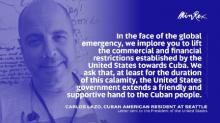
Cubaminrex, 26 april 2020. Letter sent to the President of the United States by Carlos Lazo, Cuban American resident at Seatle.

Cubaminrex, 26 april 2020. Letter sent to the President of the United States by Carlos Lazo, Cuban American resident at Seatle.
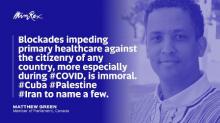
Cubaminrex, 26 April 2020. Blockades impeding primary healthcare against the citizenry of any country, more especially during Covid-19, is immoral. Cuba, Palestine, Iran to name a few.

Cubaminrex, 26 April 2020. One thousand 238 Cuban health professionals, integrated into 21 “Henry Reeve” medical brigades, have left for 20 nations in Europe, Latin America and the Caribbean, Africa and the Middle East, in the midst of the pandemic, to help contain those affected territories the spread of a virus, which we already know, will be won only with cooperation and solidarity.

Cubanews, 13 April 2020. The Cuban-American teacher Carlos Lazo, a veteran of the Iraq war, has addressed President Donald Trump directly to ask him to “extend a hand of solidarity” to the people of Cuba and lift the sanctions against the island at this time of crisis in the face of the COVID-19 pandemic.
In view of the epidemiological situation caused by the novel coronavirus (SARS CoV 2/Covid-19), the Consular Section of the Embassy of the Republic of Cuba in Helsinki, from Monday, 23 March 2020 until further notice, has established that all consular and migratory services must be requested and processed by post. For enquiries regarding consular services and details for the payment, please send an email to: cuba@cuba.fi with copy to: consulcuba@cuba.fi

Two days after Zimbabwe’s declaration of independence, on April 20 1980, Cuba and Zimbabwe formally established their diplomatic relations. However, the relationship between the two countries went way back to the ’70s, during the liberation struggle for Zimbabwe. Despite the geographical distance between the two countries, Cuba and Zimbabwe have many things in common, among them, the hospitality and solidarity of its people, and the strong desire for freedom. Both countries have paid a high price to keep their independence. As part of Cuba’s policy towards Africa, former president Fidel Castro offered a solidarity hand to the newly minted country of Zimbabwe. Through the bilateral economic commission, collaborative programmes, mainly in health and education, ensued. Zimbabwe needed a professional labour force to achieve the socio-economic and political development for the post-independence period. Therefore, the first group of young Zimbabweans left for Havana in November 1980 to study towards attainment of science degrees. The journey was not without challenges. All studies were in Spanish and they had to adapt to the Cuban culture and food. They joined the educational training programme, based on the ideas of Commander-in-Chief Fidel Castro.
The programme capacitated educational skills to thousands of young people from Africa, Asia and Latin America. More than 1 000 Zimbabweans have been trained in diverse areas throughout Cuban universities. The University of Bindura in Mashonaland Central is as a result of the bilateral cooperation between Cuba and Zimbabwe. It was the brainchild of former presidents, Robert Gabriel Mugabe and Fidel Castro of Zimbabwe and Cuba respectively. This was to enhance human capital development in Zimbabwe by bringing the science teacher education programme back from Cuba. In the health sector, backdated to 1987, Cuba has consistently deployed a medical brigade that has provided medical services in both urban and rural settings.
The assigned medical teams have selflessly reached out to the remote and difficult to access areas, bringing the service to areas lacking in primary medical care. Hundreds of Cuban medical doctors, nurses and technicians have had the privilege of serving in Zimbabwe. They have also faced the challenges of communicating with patients in English and local languages, more-so to adapt to a new cultural environment. Despite all these challenges, they have not been deterred, they have worked hard to improve the local health indicators, training human resources and improving the quality of processes in the Zimbabwean national health system. Without doubt, the Cuban medical brigade has been an example of self-sacrifice, good ethics and humanitarianism. The Zimbabwean Government has demonstrated true friendship to Cuba, in bad and good times. Together we have worked in different international scenarios. In spite of the economic and political pressures imposed on Cuba by hostile countries, Zimbabwe stood resolute in support of Cuba. To date Zimbabwe supports the Cuban fight against sanctions imposed by the United States of America.
The new generation of Cuban leaders, born and raised during the revolution, is committed to the principles and ideas of patriotism and internationalism inspired by Commander-in-Chief Fidel Castro. Cuban President Miguel Diaz Canel has reiterated his commitment to these ideals, saying: “Cuba will not renounce a single of its principles, nor make concessions inherent to its sovereignty and independence. Cuba will remain firm in defending its revolutionary and anti-imperialist ideals and in supporting the self-determination of the peoples.” During these 40 years of friendship, Cuba and Zimbabwe have developed an exemplary relationship based on respect and mutual support. Both countries are in a position to continue strengthening the bilateral bonds and even open new avenues to consolidate cooperation. Unity and solidarity in defence of common objectives and interests are the only alternatives to the enormous dangers and challenges facing the international community.

Since the announcement of the travel regulations to and from Cuba, a measure adopted by the Cuban authorities as part of the national plan to prevent and combat COVID-19, more than two thousand Cubans have returned to the national territory, by air or sea, since last March 20th, from a dozen countries, including Germany, Angola, Barbados, Guatemala, Guyana, Haiti, Italy, Nicaragua, Peru, Portugal, Dominican Republic, Mexico, Panama and Equatorial Guinea.

A group of Cuban health professionals is already in Pretoria, to be deployed soon all over South Africa, in support to the fight against Covid-19, as a sample of international solidarity among peoples.

Havana, Apr 24 Cuban Foreign Minister Bruno Rodríguez said today that humanity demands an effective solution to Covid-19, a pandemic that affects the majority of the planet.
In his account of the social network Twitter, the Chancellor stressed that this is a crisis of multiple and devastating effects not only in the field of health, but also in the economy, international trade and society.
The Minister urged to unite international efforts and stressed that "together we can achieve it."

