
Message from the Permanent Delegation of Cuba to UNESCO to Pope Leo XIV on the occasion of his upcoming visit to the Organization’s Headquarters

Paris, 21 September 2026.- Ambassador María del Carmen Herrera Caseiro, Permanent Delegate of Cuba to UNESCO, signed the message to His Holiness Pope Leo XIV in the book that will be presented to him on the occasion of his upcoming official visit to the Organization’s Headquarters, scheduled for 25 September in Paris. The visit will take place at the invitation of the Director-General of UNESCO, Khaled El-Enany, and will focus, among other issues, on human dignity, peace and dialogue.
Cuba places the impact of the U.S. blockade at the center of the debate on the vulnerabilities of Small Island Developing States

Paris, 18 September 2026. – During the extended plenary meeting of the UNESCO Group of Small Island Developing States (SIDS), held in the presence of the Director-General of the Organization, Professor Khaled El-Enany, Ambassador María del Carmen Herrera Caseiro, Permanent Delegate of Cuba to UNESCO, highlighted the need for the Organization to strengthen its attention to Small Island Developing States (SIDS), from a cross-cutting perspective that takes into account the multiple dimensions of their vulnerabilities and ensures their effective participation in defining the priorities and decisions that concern them.
In her intervention, Cuba drew particular attention to the additional dimension represented for the country by the economic, commercial and financial blockade imposed by the Government of the United States. She noted that this policy aggravates the vulnerabilities inherent to the condition of a Small Island Developing State and severely limits access to essential resources, technologies, financing and supplies.
Cuba: a strengthened UNESCO, closer to peoples, is essential to addressing challenges such as the blockade

Paris, September 15, 2026. The Permanent Delegation of Cuba to UNESCO took the floor at the meeting of the Preparatory Group for the 225th session of the UNESCO Executive Board, held on September 14 and 15 at UNESCO Headquarters.
During the consideration of the item concerning the implementation of the UNESCO80 Roadmap, the Cuban representative, Third Secretary Laura Álvarez Delgado, highlighted the work carried out by the Director-General, the Secretariat and the Chairs of the working groups responsible for its development.
She noted that, for Cuba, a country facing the consequences of the economic, commercial and financial blockade imposed by the United States, UNESCO's decisions have a concrete impact on the lives of its people. The blockade affects the country's capacity to address challenges in areas directly linked to the Organization's mandate, including education, culture, science, communication and access to knowledge.
Cuban Ambassador to UNESCO receives Algerian Ambassador on a courtesy visit

Paris, September 11, 2026.- The Ambassador and Permanent Representative of Cuba to UNESCO, María del Carmen Herrera Caseiro, received H.E. Mr. Abdelghani Merabet, the new Ambassador of Algeria to the Organization, on a courtesy visit.
Blockade vs. education: besieged Cuba stands out in the debate on the present and future of literacy in Latin America and the Caribbean
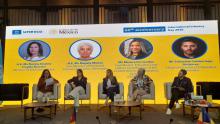
Chiapas, Mexico, September 9, 2026.- Cuba’s Minister of Education, Naima Ariatne Trujillo Barreto, participated this Wednesday in the session “Literacy for today and tomorrow in Latin America and the Caribbean,” held as part of the World Conference on “Literacy for People, the Planet and Prosperity,” taking place in Chiapas, Mexico, on September 8 and 9, convened by UNESCO and the Government of Mexico.
During its participation in the global event, the Cuban delegation denounced the reality facing the country in guaranteeing the continuity of its universal and free education system as a result of the brutal economic, commercial, financial and energy blockade imposed by the United States. The tightening of these measures over more than six decades, together with the current energy siege, has aggravated the country’s economic difficulties and directly affects the human, material, economic and financial resources required for the proper functioning of the education system.