Cuba reaffirms its leadership in the global debate on literacy

Cuba reaffirms its leadership in the global debate on literacy

Chiapas, Mexico, September 8, 2026.— Cuba’s Minister of Education, Naima Ariatne Trujillo Barreto, spoke on Tuesday at the main panel, “Literacy in the service of people, the planet and prosperity,” as part of the global celebration of International Literacy Day convened by UNESCO.

Cuba’s presence in this international forum is not fortuitous. It reflects the recognition of the country’s accumulated experience in literacy, whose starting point lies in the historic 1961 National Literacy Campaign. That educational epic made it possible for Cuba to declare itself, on December 22 of that year, the first territory free of illiteracy in Latin America. UNESCO itself has recognized the National Literacy Campaign as a landmark event in Cuban education and culture in the 20th century and as a reference for popular education movements in Latin America.

Cuba’s achievements in education are today confronted with the harsh electro-energy reality facing the country, as a consequence of the unprecedented tightening of the economic, commercial and financial blockade imposed by the Government of the United States against Cuba for more than six decades, and of its effects on access to resources, equipment, technologies and other means essential to the teaching and educational process.

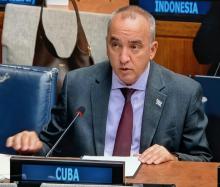
Statement by Cuban Expert Juan Fernández González, to the 7th Meeting of the Working Group on Data Governance of the Commission on Science and Technology for Development.

Mr. President,

We want to thank everyone who contributed to the drafting and review of this new version of the draft report, as it represents a step forward in fulfilling the mandate entrusted to our Group by the United Nations General Assembly.

However, despite the clear progress, there are still some topics in this version that are poorly addressed or entirely omitted.

The Human Rights Council will examine the impact of the United States blockade on the human rights of the people of Cuba

Geneva, 8 September 2026. The UN Human Rights Council will examine tomorrow, Wednesday, the impact of the economic, commercial and financial blockade and the energy siege imposed by the Government of the United States on the human rights of the Cuban people.

The President of Timor-Leste, Dr. José Ramos Horta, was the special guest at Brazil’s National Day celebration

Dili, September 8, 2026. At the Embassy of the Federation of Brazil, the keynote address for the event was delivered by Head of State Dr. José Ramos Horta, who highlighted the bonds of friendship and cooperation that unite the two nations.
For his part, Ambassador Ricardo José Lustosa Leal offered words of welcome and gratitude to the guests attending the gala celebrating the 204th anniversary of Brazil’s independence.
As a member of the diplomatic corps, the Cuban ambassador, Alina Aldama, had the opportunity to exchange views with other colleagues.

Ambassador Alina Aldama participated in the opening ceremony of the 79th meeting of the World Health Organization’s Regional Committee

Dili, September 8, 2026. At the Convention Center in the Timorese capital, Health Minister Dr. Elia A.A. Dos Reis Amaral was joined in welcoming the guests by Dr. Tedros Adhanom Ghebreyesus, Director-General of the World Health Organization; Dr. Nalinda Jayatissa, Minister of Health and Communications of Sri Lanka; and Dr. Nilesh Buddha, who heads the WHO’s Southeast Asia Regional Office.

The head of the Cuban diplomatic mission in Timor-Leste, Alina Aldama, attended the reception for the 79th meeting of the World Health Organization’s Regional Committee

Dili, September 8, 2026. At the Lahane Palace, in the presence of the country’s president, Dr. José Ramos Horta—accompanied by Health Minister Dr. Elia A.A. Dos Reis Amaral and members of the Timorese government—a welcome gala was held for the participants in the 79th session of the World Health Organization’s Regional Committee for Southeast Asia.
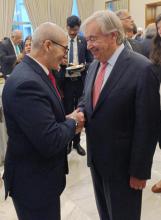
On this occasion, the Cuban ambassador, Alina Aldama, had the honor of greeting Dr. Tedros Adhanom Ghebreyesus, Director-General of the World Health Organization, who spoke highly of the Cuban healthcare system.

Cypriot daily Haravgi publishes an interview with a Cuban ambassador under the headline "They are trying to suffocate the entire Cuban nation." 

Nicosia, Cyprus, September 7: The Cypriot newspaper “Haravgi” included on its front page this Sunday, September 6, a feature and a full-page interview with the Ambassador of the Republic of Cuba in Cyprus, Rubén Pino Martínez, titled “They are trying to suffocate the entire Cuban nation,” which covers—among other topics—the consequences of the U.S. blockade on Cuba’s health, energy, and everyday life sectors. 

The interview reveals how the island is facing one of the most difficult periods in recent decades, with energy limitations and shortages that directly affect the daily lives of its people; it reflects on the consequences of the U.S. economic, commercial, and financial blockade and its impact on the national hospital system due to the lack of medicines, energy, and many other aspects of everyday Cuban life.

The Cuban ambassador, Pino Martínez, expands on the extraterritorial sanctions on third countries, talks about the new economic measures the country is taking, and the attitude that Havana expects from the international community in the face of this ongoing hostile and aggressive blockade policy against Cuba. 

Statement by Ambassador Rodolfo Benítez Verson, Permanent Representative of Cuba, during the Interactive Dialogue with the Fact-Finding Mission on Sudan

Mr. President,

The only effective way to promote human rights in all countries, including Sudan, is through dialogue and constructive cooperation, based on impartiality, mutual respect, and non-interference.

Cuba does not support the imposition in Sudan, or in any other country, of external mechanisms that cannot achieve any practical results on the ground because they lack the necessary consent of the country concerned. The Fact-Finding Mission on Sudan is one such example.

Cuba and Zambia Discuss Strengthening Bilateral and Multilateral Relations

Addis Ababa, September 7, 2026.- Cuba’s Ambassador to the African Union, Lucas D. Hernández Polledo, held a productive meeting with H.E. Mr. Albert M. Muchanga, Ambassador of the Republic of Zambia to the Federal Democratic Republic of Ethiopia and Permanent Representative to the African Union. During the meeting, both diplomats discussed the state of bilateral relations between Cuba and Zambia, highlighting their historic ties of friendship, solidarity, and cooperation.

Pages

Subscribe to CUBADIPLOMATICA RSS